Lectures
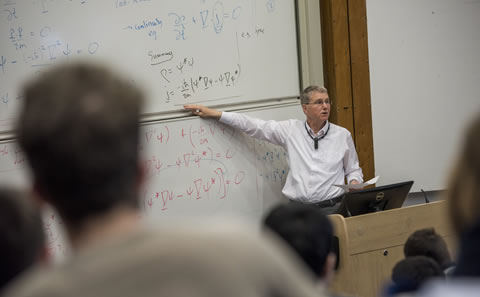
Lectures make up the main bulk of teaching time. You’ll learn from friendly academics, who are keen to share their knowledge and enthusiasm for physics with you.
Your lecturers are also active researchers, who bring their discoveries to the lecture hall as soon as they happen – meaning you’ll learn about new developments as they unfold.
We combine traditional teaching and learning methods with tried-and-tested innovations to improve your learning experience. For example, you can use interactive technology to ask a question from your seat in the lecture hall and receive a response during the session.
Tutorials
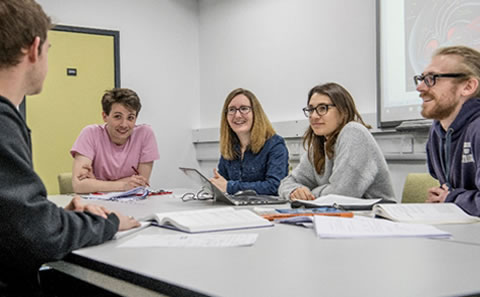
When you arrive at Southampton you’ll be assigned a personal tutor and a highly experienced senior tutor. You’ll have small-group weekly tutorials with your personal tutor, who will oversee your progress and offer help and advice throughout your degree.
As you near the end of your degree, your tutor will be there to provide careers advice, and that all- important first reference for your job.
Problems classes
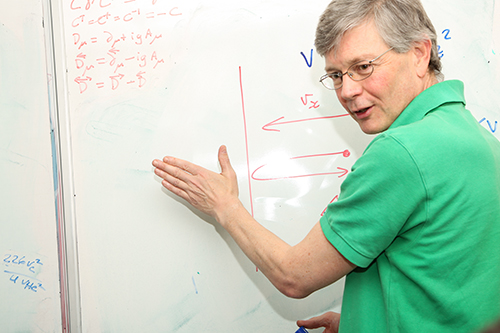
Every week, we give our students a problem sheet for each of the core modules. You’ll work on the sheets in a problems class, which have a smaller number of students than lectures. There are also plenty of demonstrators presents, so it’s easy to ask for help.
Experimental labs
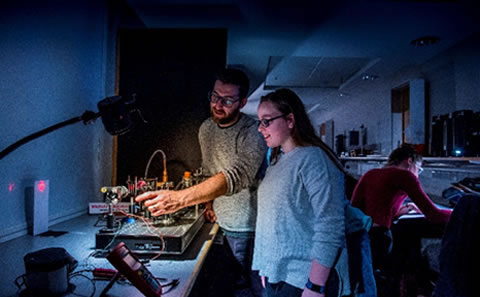
Hands-on practical work is integral to our degrees; from year one you’ll put concepts to the test in our laboratories. You’ll have around four timetabled hours of lab sessions per week – and you can also use the labs outside of those scheduled hours to work on your projects. Our expert technicians will be on hand to offer any support you need.
In year three (BSc) or year four (MPhys) you’ll work with another student on an extended research project. You can choose a field of physics that interests you; past projects have included analysing astronomy data from the Cassini satellite, investigating aspects of particle physics using CERN data and performing Raman scattering measurements on nanomaterials to study their optical, electronic and vibrational properties.
Drop-in sessions
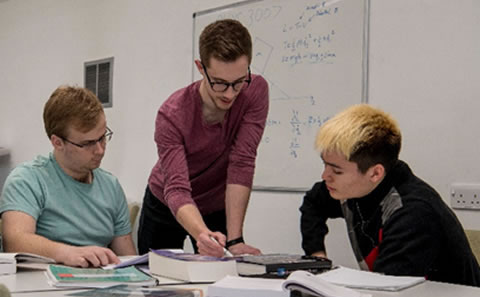
Once a week, there’s an opportunity to meet with our postgraduate students and ask any question you have about your course. Whether you’d like some support with one of your modules, help with a tricky problem sheet or just have a general physics question, they’re there to help.
Clubs and societies
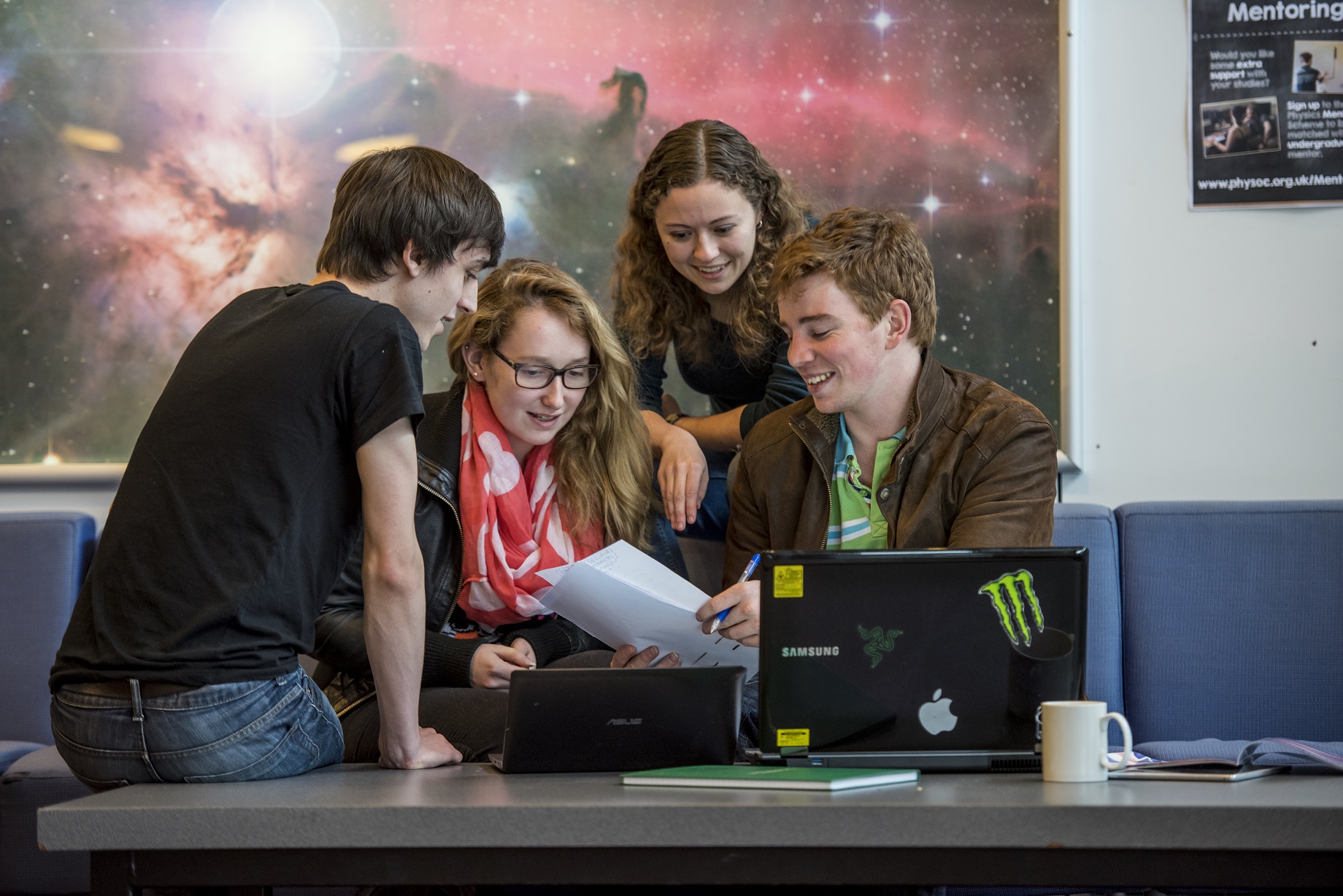
At Southampton, we place an emphasis on work-life balance, and want you to be able to take advantage of our 350 clubs and societies.
You could take part in just about anything, from archery, quidditch and performing arts, through to music, ballroom dancing and ultimate Frisbee!
And, you’ll automatically become a member of our award-winning Physics and Astronomy society, Physoc. The society organises talks, trips and socials, and also takes part in outreach activities which you can get involved in.
Publications
Asmus, D., Greenwell, C.L., Gandhi, P., Boorman, P.G., Aird, J., Alexander, D.M., Assef, R.J., Baldi, R.D., Davies, R.I., Hönig, S.F., Ricci, C., Rosario, D.J., Salvato, M., Shankar, F. and Stern, D. (2020) Local AGN Survey (LASr): I. Galaxy sample, infrared colour selection and predictions for AGN within 100 Mpc. Monthly Notices of the Royal Astronomical Society, 494 (2), 1784–1816. (doi:10.1093/mnras/staa766).
Researchers from Southampton and Bordeaux have unveiled a new technique for the industrial testing of photonics chips, an important step in the realisation of an emerging multi-billion pound industry.
The international research, presented this month in the Nature Communications journal, brings together advanced theoretical modelling and precise experimental studies to develop a quantitative understanding of how light travels through a chip.
Photonic integrated circuits, the technology of using light on a chip, is a rapidly developing industry with applications in data communication and optical interconnects.
Whereas electronic testing of circuits is a mature field, capabilities are still lacking for photonic circuits and not well-suited to industrial-scale testing. There is therefore a strong need to develop advanced probes capable of testing fabricated devices remotely and with high throughput.
Researchers from the Department of Physics and Astronomy at the University of Southampton and the Laboratory for Photonics, Numerics and Nanosciences (LP2N) in Bordeaux, France, have demonstrated the new technique which uses a pulsed laser to divert and then measure the flow of light through a device.
The theory used to interpret these results applies to many photonic systems with great accuracy and minimal computational cost. Comparisons between the experimentally obtained and modelled maps for the devices showed agreement as high as 95%, a clear indication of the robustness of the model and of the experimental technique.
Professor Otto Muskens,, from Southamptonâs Integrated Nanophotonics Group and Principal Investigator of the study, says: "Our new technique will be of interest for photonics industry and we are actively looking for end users to test our methods in real-world applications. Further development will be needed to explore the integration of the technique into actual probe stations used by industry, ultimately merging optical and electronic testing onto one single platform.â?
The work was supported by the UK Silicon Photonics for Future Systems research programme and involved Southamptonâs state-of-the-art cleanroom facilities and the Silicon Photonics research group led by Professor Graham Reed.
Articles that may also interest you

Andreas Jüttner is an Professor of Theoretical Physics in the Southampton High Energy Physics Group. After graduating from Friedrich-Alexander Universität Erlangen-Nürnberg he did a PhD in Computational Particle Physics at the Humboldt Universität zu Berlin. After his time as a post doc in Southampton and Mainz (Germany) he spent time at CERN in Geneva, Switzerland, as a CERN Fellow in the Theory Department. He returned to Southampton on an European Research Council Starting Grant in 2012. Andreas is currently on leave of absence on a staff position in the CERN Theory Department.
Until 05/2021 Andreas was director of the EPSRC Centre for Doctoral Training "Next Generation Computational Modelling". He is founding member of the Flavour Lattice Averaging Group (FLAG) where he is currently on the Editorial Board.
Research
Research interests
Andreas' research focuses on understanding the fundamental constituents of matter. He is particularly interested in the theory of strong interactions that describes how quarks and gluons interact to form mesons and baryons (e.g. protons, which make up the visible matter surrounding us). His research addresses the many unresolved questions still remaining such as why there is more matter than anti-matter in the universe and how the universe began. His results help understanding experimental findings coming in from the experimental facilities at e.g. the LHC at CERN in Switzerland (e.g.LHCb), KEK in Japan (BelleII), Fermilabin the US (g-2) and J-PARC in Japan (g-2).
Andreas is also interested in the development and improvement of simulations algorithms and in applying lattice techniques in other research areas. The aspects of the strong interaction Andreas is most interest in can be understood by means of numerical simulations, solving the equations of motion on high performance computers (Lattice Quantum Field Theory). To this end he is PI for a large computing time grant on DiRAC's super computers and he is also using computing resources for instance in the US or Southampton's Iridis compute cluster. He is member of the RBC/UKQCD collaboration and he is collaborating with researchers from Edinburgh, the US (Columbia University, Brookhaven National lab), Germany, Denmark and Japan (KEK).
More recently Andreas is using his expertise to address questions in Holographic Cosmology and Machine Learning.
Publications
Boyle, P.A., Flynn, J.M., Juttner, A., Kenway, R.D., Sachrajda, C.T., Sasaki, S., Soni, A., Tweedie, R.J. and Zanotti, J.M. (2007) K(l3) form factor with N(f) = 2+1 dynamical domain wall fermions: A progress report. Journal of Physics: Conference Series, 110, 102012 -[6pp]. (doi:10.1088/1742-6596/110/10/102012).
Flynn, J.M., Juttner, A., Sachrajda, C.T., Boyle, P.A. and Zanotti, J.M (2007) Hadronic form factors in lattice QCD at small and vanishing momentum transfer. Journal of High Energy Physics, 5, 16-37. (doi:10.1088/1126-6708/2007/05/016).
Boyle, P.A., Donnellan, M.A., Flynn, J.M., Juttner, A., Noaki, J., Sachrajda, C.T. and Tweedie, R.J. (2006) A lattice computation of the first moment of the kaon's distribution amplitude. Physics Letters B, 641 (1), 67-74. (doi:10.1016/j.physletb.2006.07.033).
Antonio, D., Boyle, P.A., Donnellan, M.A., Flynn, J., Juttner, A., Maynard, C., Pendleton, B., Sachrajda, C.T. and Tweedie, R. (2007) Lattice results for vector meson couplings and parton distribution amplitudes. Bali, Gunnar, Braun, Vladimir, Gattringer, Christof, Göckeler, Meinulf, Schäfer, Andreas, Weisz, Peter and Wettig, Tilo (eds.) In Proceedings of Lattice 2007, The XXV International Symposium on Lattice Field Theory. International School for Advanced Studies. 7 pp .
Flynn, Jonathan, Juttner, Andreas, Sachrajda, Christopher and Villadoro, Giovanni (2006) Partially twisted boundary conditions in lattice simulations. In Proceedings of Science (PoS) LAT2005. Proceedings of Science. pp. 352-357 .
Aoki, Y., Boyle, P.A., Christ, N.H., Dawson, C., Donnellan, M.A., Izubuchi, T., Jüttner, A., Li, S., Mawhinney, R.D., Noaki, J., Sachrajda, C., Soni, A., Tweedie, R.J. and Yamaguchi, A. (2008) Nonperturbative renormalization of quark bilinear operators and Bk using domain wall fermions. Physical Review D, 78 (5), 054510-[28pp]. (doi:10.1103/PhysRevD.78.054510).
Boyle, P.A., Flynn, J.M., Juttner, A., Kelly, C., Maynard, C., de Lima, H. Pedroso, Sachrajda, C.T. and Zanotti, J.M. , (2010) K→π form factors with reduced model dependence. The European Physical Journal C, 69 (1-2), 159-167. (doi:10.1140/epjc/s10052-010-1405-4).
Antonelli, M., Asner, D.M., Bauer, D., Becher, T., Beneke, M., Bevan, A.J., Blanke, M., Bloise, C., Bona, M., Bondar, A., Bozzi, C., Brod, J., Buras, A.J., Cabibbo, N., Carbone, A., Cavoto, G., Cirigliano, V., Ciuchini, M., Coleman, J.P., Cronin-Hennessy, D.P., Dalseno, J.P., Davies, C.H., DiLodovico, F., Dingfelder, J., Dolezal, Z., Donati, S., Dungel, W., Egede, U., Eigen, G., Faccini, R., Feldmann, T., Ferroni, F., Flynn, J.M., Franco, E., Fujikawa, M., Furic, I.K., Gambino, P., Gardi, E., Gershon, T.J., Giagu, S., Golowich, E., Goto, T., Greub, C., Grojean, C., Guadagnoli, D., Haisch, U.A., Harr, R.F., Hoang, A.H., Hurth, T., Isidori, G., Jaffe, D.E., Jüttner, A., Jäger, S., Khodjamirian, A., Koppenburg, P., Kowalewski, R.V., Krokovny, P., Kronfeld, A.S., Laiho, J., Lanfranchi, G., Latham, T.E., Libby, J., Limosani, A., Pegna, D.Lopes, Lu, C.D., Lubicz, V., Lunghi, E., Lüth, V.G., Maltman, K., Marciano, W.J., Martin, E.C., Martinelli, G., Martinez-Vidal, F., Masiero, A., Mateu, V., Mescia, F., Mohanty, G., Moulson, M., Neubert, M., Neufeld, H., Nishida, S., Offen, N., Palutan, M., Paradisi, P., Parsa, Z., Passemar, E., Patel, M., Pecjak, B.D., Petrov, A.A., Pich, A., Pierini, M., Plaster, B., Powell, A., Prell, S., Rademaker, J., Rescigno, M., Ricciardi, S., Robbe, P., Rodrigues, E., Rotondo, M., Sacco, R., Schilling, C.J., Schneider, O., Scholz, E.E., Schumm, B.A., Schwanda, C., Schwartz, A.J., Sciascia, B., Serrano, J., Shigemitsu, J., Shipsey, I.J., Sibidanov, A., Silvestrini, L., Simonetto, F., Simula, S., Smith, C., Soni, A., Sonnenschein, L., Sordini, V., Sozzi, M., Spadaro, T., Spradlin, P., Stocchi, A., Tantalo, N., Tarantino, C., Telnov, A.V., Tonelli, D., Towner, I.S., Trabelsi, K., Urquijo, P., van de Water, R.S., van Kooten, R.J., Virto, J., Volpi, G., Wanke, R., Westhoff, S., Wilkinson, G., Wingate, M., Xie, Y. and Zupan, J. (2009) Flavor physics in the quark sector. Pre-print, (arXiv:0907.538), 1-342.
Boyle, P.A., Kelly, C., Maynard, C., Zanotti, J.M., Flynn, J.M., Pedroso de Lima, H., Sachrajda, C.T. and Juttner, A. (2009) Determining the Kl3 form factors directly at zero momentum transfer. XXVII International Symposium on Lattice Field Theory (LAT2009), Beijing, China. 25 - 30 Jul 2009. 7 pp .
Della Morte, Michele, Jäger, Benjamin, Juttner, Andreas and Wittig, Hartmut (2012) Towards a precise lattice determination of the leading hadronic contribution to (g-2)_mu. Journal of High Energy Physics, 2012 (3), 1-19. (doi:10.1007/JHEP03(2012)055).
Morte, Michele Della, Dürr, Stephan, Guazzini, Damiano, Sommer, Rainer, Heitger, Jochen and Jüttner, Andreas , (2008) Heavy-strange meson decay constants in the continuum limit of quenched QCD. Journal of High Energy Physics, 2008 (2), 1-28. (doi:10.1088/1126-6708/2008/02/078).
Boyle, P.A., Kelly, C., Kenway, R.D. and Jüttner, A. (2008) Use of stochastic sources for the lattice determination of light quark physics. Journal of High Energy Physics, 2008 (08/086), 1-24. (doi:10.1088/1126-6708/2008/08/086).
Capitani, S., Della Morte, M., von Hippel, G., Jäger, B., Jüttner, A., Knippschild, B., Meyer, H. B. and Wittig, H. (2012) Nucleon axial charge in lattice QCD with controlled errors. Physical Review D, 86 (7), 074502-[6 pages]. (doi:10.1103/PhysRevD.86.074502).
Boyle, P. A., Flynn, J. M., Garron, N., Jüttner, A., Sachrajda, C. T., Sivalingam, K. and Zanotti, J. M. (2013) The kaon semileptonic form factor with near physical domain wall quarks. Journal of High Energy Physics, 2013 (8). (doi:10.1007/JHEP08(2013)132).
Jüttner, A., Flynn, J.M., Sachrajda, C.T., Boyle, P.A., Mawhinney, R.D., Yin, H., Garron, N. and Sivalingam, K. (2013) Kaon semileptonic decay from the SU(3)-symmetric point down to physical quark masses. LATTICE 2013: 31st International Symposium on Lattice Field Theory, Mainz, Germany. 28 Jul - 02 Aug 2013.
Brandt, Bastian B., Juttner, Andreas and Wittig, Hartmut (2013) The pion vector form factor from lattice QCD and NNLO chiral perturbation theory. Journal of High Energy Physics, 11 (34), 1-37. (doi:10.1007/JHEP11(2013)034).
Juttner, A. and Sachrajda, C.T. , (2014) Review of lattice results concerning low-energy particle physics. The European Physical Journal C, 74, [2890]. (doi:10.1140/epjc/s10052-014-2890-7).
Blum, T., Boyle, P.A., Christ, N.H., Frison, J., Garron, N., Hudspith, R.J., Izubuchi, T., Janowski, T., Jung, C., Jüttner, A., Kelly, C., Kenway, R.D., Lehner, C., Marinkovic, M., Mawhinney, R.D., McGlynn, G., Murphy, D.J., Ohta, S., Portelli, A., Sachrajda, C.T. and Soni, A. (2016) Domain wall QCD with physical quark masses. Physical Review D, 93 (7), 1-68. (doi:10.1103/PhysRevD.93.074505).
Cho, Yong-Gwi, Hashimoto, Shoji, Juttner, Andreas, Kaneko, Takashi, Marinkovic, Marina, Noaki, Jun-Ichi and Tsang, Justus Tobias (2015) Improved lattice fermion action for heavy quarks. Journal of High Energy Physics, 2015 (72), 1-32. (doi:10.1007/JHEP05(2015)072).
Boyle, P.A., Christ, N.H., Flynn, J.M., Garron, N., Jung, C., Juttner, A., Mawhinney, R.D., Murphy, D., Sachrajda, C.T., Sanfilippo, F. and Yin, H. (2015) The kaon semileptonic form factor in N f = 2 + 1 domain wall lattice QCD with physical light quark masses. Journal of High Energy Physics, 2015 (164), 1-22. (doi:10.1007/JHEP06(2015)164).
Boyle, P.A., Christ, N.H., Garron, N., Jung, C., Juttner, A., Kelly, C., Mawhinney, R.D., McGlynn, G., Murphy, D.J., Ohta, S., Portelli, A. and Sachrajda, C.T. (2016) Low energy constants of SU(2) partially quenched chiral perturbation theory from Nf=2+1 domain wall QCD. Physical Review D, 93 (5), 1-43. (doi:10.1103/PhysRevD.93.054502).
Blum, T., Boyle, P. A., Del Debbio, L., Hudspith, R. J., Izubuchi, T., Juttner, A., Lehner, C., Lewis, R., Maltman, K., Krstic Marinkovic, M., Portelli, A. and Spraggs, M. (2016) Lattice calculation of the leading strange quark-connected contribution to the muon g - 2. Journal of High Energy Physics, 2016 (63), 1-20. (doi:10.1007/JHEP04(2016)063).
Boyle, P., Juttner, A., Krstic Marinkovic, M., Sanfilippo, F., Spraggs, M. and Tsang, J.T. (2016) An exploratory study of heavy domain wall fermions on the lattice. Journal of High Energy Physics, 2016 (37), 1-24. (doi:10.1007/JHEP04(2016)037).
Blum, T., Boyle, P.A., Izubuchi, T., Jin, L., Juttner, A., Lehner, C., Maltman, K., Marinkovic, M., Portelli, A. and Spraggs, M. (2016) Calculation of the hadronic vacuum polarization disconnected contribution to the muon anomalous magnetic moment. Physical Review Letters, 116 (23), 1-6, [232002]. (doi:10.1103/PhysRevLett.116.232002).
Christ, Norman H., Feng, Xu, Jüttner, Andreas, Lawson, Andrew, Portelli, Antonin and Sachrajda, Christopher T. (2016) First exploratory calculation of the long-distance contributions to the rare kaon decays K→πℓ+ℓ-. Physical Review D, 94 (11), 1-18, [114516]. (doi:10.1103/PhysRevD.94.114516).
Juttner, Andreas , (2017) Review of lattice results concerning low-energy particle physics. The European Physical Journal C, 77, [112]. (doi:10.1140/epjc/s10052-016-4509-7).
Jüttner, Andreas, Litim, Daniel F. and Marchais, Edouard (2017) Global Wilson–Fisher fixed points. Nuclear Physics B, 921, 769-795. (doi:10.1016/j.nuclphysb.2017.06.010).
Boyle, P., Gülpers, V., Harrison, J., Jüttner, A., Lehner, C., Portelli, A. and Sachrajda, C.T. (2017) Isospin breaking corrections to meson masses and the hadronic vacuum polarization: a comparative study. Journal of High Energy Physics, 2017 (9), [153]. (doi:10.1007/JHEP09(2017)153).
Boyle, P.A., Del Debbio, L., Jüttner, A., Khamseh, A., Sanfilippo, F. and Tsang, J.T. , (2017) The decay constants fD and fDs in the continuum limit of N=2+1 domain wall lattice QCD. Journal of High Energy Physics, 12 (12), [8]. (doi:10.1007/JHEP12(2017)008).
Boyle, Peter, Hudspith, Renwick James, Izubuchi, Taku, Jüttner, Andreas, Lehner, Christoph, Lewis, Randy, Maltman, Kim, Ohki, Hiroshi, Portelli, Antonin and Spraggs, Matthew (2018) | Vus | determination from inclusive strange tau decay and lattice HVP. EPJ Web of Conferences, 175, 1-8, [13011]. (doi:10.1051/epjconf/201817513011).
Boyle, Peter, Gülpers, Vera, Harrison, James, Jüttner, Andreas, Portelli, Antonin and Sachrajda, Christopher (2018) Numerical investigation of finite-volume effects for the HVP. EPJ Web of Conferences, 175, 1-8, [06022]. (doi:10.1051/epjconf/201817506022).
Cossu, Guido, Boyle, Peter, Christ, Norman, Jung, Chulwoo, Jüttner, Andreas and Sanfilippo, Francesco (2018) Testing algorithms for critical slowing down. EPJ Web of Conferences, 175, [02008]. (doi:10.1051/epjconf/201817502008).
Boyle, Peter A., Debbio, Luigi Del, Jüttner, Andreas, Khamseh, Ava, Tsang, Justus Tobias and Witzel, Oliver (2018) Heavy domain wall fermions: The RBC and UKQCD charm physics program. EPJ Web of Conferences, 175, [13013]. (doi:10.1051/epjconf/201817513013).
Boyle, Peter, Guelpers, Vera, Harrison, James, Juettner, Andreas, Lehner, Christoph, Portelli, Antonin and Sachrajda, Christopher (2018) Isospin breaking corrections to the HVP with Domain Wall fermions. EPJ Web of Conferences, 175, [06024]. (doi:10.1051/epjconf/201817506024).
Blum, T., Boyle, P.A., Gülpers, V., Izubuchi, T., Jin, L., Jung, C., Jüttner, A., Lehner, C., Portelli, A. and Tsang, J.T. , (2018) Calculation of the Hadronic vacuum polarization contribution to the Muon anomalous magnetic moment. Physical Review Letters, 121 (2), [022003]. (doi:10.1103/PhysRevLett.121.022003).
Boyle, Peter, Hudspith, Renwick James, Izubuchi, Taku, Jüttner, Andreas, Lehner, Christoph, Lewis, Randy, Maltman, Kim, Ohki, Hiroshi, Portelli, Antonin and Spraggs, Matthew (2018) Novel |Vus | determination using inclusive strange τ decay and lattice Hadronic vacuum polarization functions. Physical Review Letters, 121 (20), 1-6, [202003]. (doi:10.1103/PhysRevLett.121.202003).
Davoudi, Zohreh, Harrison, James, Jüttner, Andreas, Portelli, Antonin and Savage, Martin J. (2019) Theoretical aspects of quantum electrodynamics in a finite volume with periodic boundary conditions. Physical Review D, 99, [034510]. (doi:10.1103/PhysRevD.99.034510).
Flynn, Jonathan M., Hill, Ryan C., Jüttner, Andreas, Soni, Amarjit, Tsang, Justus Tobias and Witzel, Oliver (2019) Semi-leptonic form factors for Bs→ K\ell ν and Bs → Ds \ell ν. Proceedings of Science, Lattice2018.
Flynn, Jonathan, Jüttner, Andreas, Kawanai, Taichi, Lizarazo, Edwin and Witzel, Oliver (2015) Hadronic form factors for rare semileptonic B decays. Proceedings of Science, LATTICE2015, [345].
Flynn, Jonathan, Izubuchi, Taku, Juttner, Andreas, Kawanai, Taichi, Lehner, Christoph, Lizarazo, Edwin, Soni, Amarjit, Tsang, Justus Tobias and Witzel, Oliver (2016) Form factors for semi-leptonic B decays. Proceedings of Science, LATTICE2016, [296].
Bijnens, J., Harrison, J., Hermansson-Truedsson, N., Janowski, T., Jüttner, A. and Portelli, A. (2019) Electromagnetic finite-size effects to the hadronic vacuum polarization. Physical Review D, 100 (1), 1-22, [014508]. (doi:10.1103/PhysRevD.100.014508).
Hermansson-Truedsson, Nils, Bijnens, Johan, Harrison, James, Janowski, Tadeusz, Jüttner, Andreas and Portelli, Antonin (2020) Electromagnetic finite-size effects to the hadronic vacuum polarisation. Proceedings of Science, 363. (doi:10.22323/1.363.0018).
Lee, Joseph K. L., Debbio, Luigi Del, Jüttner, Andreas, Portelli, Antonin and Skenderis, Kostas (2020) Towards a holographic description of cosmology: Renormalisation of the energy-momentum tensor of the dual QFT. PoS.
Cossu, Guido, Del Debbio, Luigi, Juttner, Andreas, Kitching-Morley, Ben, Lee, Joseph K. L., Portelli, Antonin, Rocha, Henrique Bergallo and Skenderis, Kostas (2021) Nonperturbative infrared finiteness in super-renormalisable scalar quantum field theory. Physical Review Letters, 126 (22), [221601]. (doi:10.1103/PhysRevLett.126.221601).
Debbio, Luigi Del, Dobson, Elizabeth, Jüttner, Andreas, Kitching-Morley, Ben, Lee, Joseph K. L., Nourry, Valentin, Portelli, Antonin, Rocha, Henrique Bergallo and Skenderis, Kostas (2021) Renormalisation of the energy-momentum tensor in three-dimensional scalar $SU(N)$ theories using the Wilson flow. Physical Review D, 103 (11), [114501]. (doi:10.1103/PhysRevD.103.114501).
(2022) Data for Thesis "$B\to\pi\ell\nu$ and $B_s\to K\ell\nu$ decays in the Continuum Limit of Lattice QCD". University of Southampton doi:10.5258/SOTON/D2195 [Dataset]
Boyle, Peter A., Chakraborty, Bipasha, Davies, Christine T. H., DeGrand, Thomas, DeTar, Carleton, Debbio, Luigi Del, El-Khadra, Aida X., Erben, Felix, Flynn, Jonathan M., Gámiz, Elvira, Giusti, Davide, Gottlieb, Steven, Hansen, Maxwell T., Heitger, Jochen, Hill, Ryan, Jay, William I., Jüttner, Andreas, Koponen, Jonna, Kronfeld, Andreas, Lehner, Christoph, Lytle, Andrew T., Martinelli, Guido, Meinel, Stefan, Monahan, Christopher J., Neil, Ethan T., Portelli, Antonin, Simone, James N., Simula, Silvano, Sommer, Rainer, Soni, Amarjit, Tsang, J. Tobias, Water, Ruth S. Van de, Vaquero, Alejandro, Vittorio, Ludovico and Witzel, Oliver (2022) A lattice QCD perspective on weak decays of b and c quarks: Snowmass 2022 White Paper. 2021 Snowmass: Summer Study, Seattle, WA, United States, Seattle, United States. 11 - 17 Jul 2021.
[Unknown type: UNSPECIFIED]
[Unknown type: UNSPECIFIED]
[Unknown type: UNSPECIFIED]
[Unknown type: UNSPECIFIED]
[Unknown type: UNSPECIFIED]
[Unknown type: UNSPECIFIED]
[Unknown type: UNSPECIFIED]
[Unknown type: UNSPECIFIED]
[Unknown type: UNSPECIFIED]
Contact
Telephone: +44 (0) 23 8059 7343
Email: juettner@soton.ac.uk
Staff in Physics and Astronomy at the University of Southampton are constantly shaping the subjectâs education and research environment by publishing findings and expressing expert opinion. Hereâs a round-up of some of our most recent achievements:
Supersymmetry Beyond Minimality
Southamptonâs Professor Stefano Moretti and Professor Shaaban Khalil, General Director of Research at Zewail City of Science and Technology, Egypt, have published Supersymmetry Beyond Minimality: From Theory to Experiment. This graduate textbook and researcher reference guide to supersymmetry, an extension of the Standard Model of Particle Physics, includes the latest results from data analyses of the Large Hadron Collider (LHC).
Cosmology and the Early Universe
Professor Pasquale Di Bari explores cosmology, the study of the origin and evolution of the universe, in his new book Cosmology and the Early Universe. This undergraduate textbook contains a discussion of modern cosmology results, including the detection of gravitational waves which was recognised by the Nobel Prize for Physics in 2017.
Theories of Matter, Space and Time
Professor Nick Evans and Professor Steve King from the Southampton High Energy Physics (SHEP) Group have co-authored Theories of Matter, Space and Time, Volume 1, an undergraduate guide through topics covered in the third and fourth year of courses at Southampton. The book offers sophisticated views of classical mechanics, special relativity, electromagnetism and quantum theory and addresses their interdependence.
Understanding Nothing
Professor Nick Evans has also released short read Understanding Nothing this spring, a written version of a popular talk covering early ideas of the vacuum, Newtonian gravity, relativity and quantum theory, leading up to the discovery of the Higgs boson and the outstanding problem of a full quantum theory of gravity.
Articles that may also interest you
Physicists from the University of Southampton have used simulations on high performance computers to determine the properties of a fundamental particle with unprecedented precision.
Comparisons of the super computer calculation with data from international experiments could either confirm or challenge the Standard Model of Particle Physics, a long-established theory for fundamental particles and how they interact.
Researchers in the Southampton High Energy Physics (SHEP) theory group are working with international partners to predict the effects of magnetic fields on muons, an unstable subatomic particle with properties similar to an electron. Their calculation of the hadronic vacuum polarisation contribution to the muon anomalous magnetic moment is part of a Standard Model prediction that will be compared to the results of experiments taking place in the USA and Japan.
The groupâs research paper has been accepted for publication in the prestigious journal Physical Review Letters and selected for the âEditorsâ Suggestionâ, which highlights papers that are âparticularly important, interesting and well writtenâ?.
Dr Andreas Jüttner, a Principal Research Fellow in Physics and Astronomy, explains, âOver the last few decades physicists have developed a comprehensive understanding of theoretical physics, crowned by the discovery of the Higgs boson in 2012 and leading to the award of the 2013 Nobel Prize in Physics to Englert and Higgs. There is a lot of other evidence however that our current understanding is not the full picture of nature. Indeed, known matter only makes a few percent of the nature of the universe, so there is a lot left to explain.
âOur strategy has been to make precise theoretical predictions and confront them with precise experimental measurements. Itâs really exciting since we managed to make our prediction before the experiment publishes new data early in 2019.â?
The Southampton research team involved in the project received support from Andreasâ European Research Council Starting Grant and included postdoctoral researchers Dr Vera Gülpers, Dr Antonin Portelli and Dr Justus Tobias Tsang. They are working with partners at the University of Edinburgh, Columbia University, Brookhaven National Lab and the University of Connecticut.
The research has used a method called Lattice Quantum Chromodynamics (Lattice QCD). Its calculation is performed by constructing a discrete four-dimensional space-time grid, known as the lattice, to numerically solve the QCD equations of motion. Such lattice QCD simulations are the only known method to address certain questions without having to rely on ad hoc assumptions.
This type of computation crucially relies on access to the worldâs fastest parallel supercomputers and this research has benefited from a computing time grant from DiRAC, Distributed Research utilising Advanced Computing.
Andreas adds, âWe are looking forward to finding out whether the Standard Model of Particle Physics will be confirmed by experiments taking place this year, but if they disagree it will be the strongest possible indication that we have found new physics.â?
Articles that may also interest you
Physics and Astronomy at the University of Southampton has risen into the top 10 for subject rankings in the 2019 Guardian University Guide. Physics rose six places to be ranked sixth in the guide, with a 99.0 out of 100 score positioning it second in the country â and first in the Russell Group â for satisfaction with the course.
The Guardian University Guide ranks 121 UK institutions and focuses on undergraduate study and experience. Rankings are based around criteria of entry tariffs, student satisfaction, graduate prospects, student-staff ratio and university spend per student.
Professor Jonathan Flynn, Head of Physics and Astronomy, says: âWe are thrilled to be sixth in the Guardian league table for Physics, and first in the Russell Group for overall student satisfaction. The Guardian University Guide emphasises the students' perspective and we think our top 10 position reflects the effort we make to support our students. We will not be complacent, however, and will continue to work to improve our students' experience and their future prospects.â?
Physics and Astronomy is joined in the top 10 by other subjects in the Faculty of Physical Sciences and Engineering; Computer Science and Information Systems is ranked 8th and Electrical and Electronic Engineering (EEE) is 2nd .
Professor Bashir Al-Hashimi, Dean of Physical Sciences and Engineering, adds: âEEE is consistently ranked among the best departments in the UK and this outstanding result reinforces that the University and Electronics and Computer Science provide educational experience and training of the highest quality to our students. I am also delighted that Computer Science and Physics are among the top 10 in their disciplines, which is a fantastic achievement. Such consistent results are testament to the expertise and commitment of our staff as well as the leadership at a Department and Faculty level.â?
The University of Southampton rose 12 places to be ranked 23rd overall in the 2019 guide. The improvement comes a month after the Universityâs return to the top 20 in the 2019 Complete University Guide.
View the 2019 university league tables in full via the Guardian University Guide website.
Related Links
The University cannot accept responsibility for external websites.