The University of Southampton

Published: 23 August 2018
Illustration
The Optical Multi-Parameter Analyser is a portable and compact instrument, for measuring and characterising liquid crystal cells

Researchers at the University of Southampton have invented a cost-effective tool for the research, development and study of the latest liquid crystal displays.

The Optical Multi-Parameter Analyser, or OMPA, is an all-in-one instrument for the characterisation of liquid crystal cells, an essential component in the screens of televisions, computers and tablets that dominate our contemporary lives.

The equipment builds upon years of cutting-edge research in the Soft Photonics Systems (SoPHT) Group, which combines expertise from Southampton’s Schools of Physics and Astronomy and Mathematical Sciences.

“Liquid crystals are used in devices that are all around us, but in order to develop these incredible applications, liquid crystal engineers and researchers need specialist equipment to measure and characterise key properties of liquid crystal cells,â€? Professor Malgosia Kaczmarek explains. “They need to know how fast and reliable the devices are and whether parameters, like their optical quality, change in time and with use. OMPA uses powerful data analysis techniques with cross-polarised intensity measurements to determine liquid crystal parameters.

“Unlike its competitors, OMPA is a portable and compact instrument. The technology is enabling researchers to answer vital questions that enable key advances in our industry, for example, new un-doped or functionalised liquid crystals or the alignment of liquid crystals with photo-active polymers.

“OMPA not only operates with standard liquid crystal cells but can also be customised to measure parameters in assembled devices, making it suitable for long-term stability measurements. “You can use it in your laboratory, but it can also be deployed as an ideal teaching instrument,â€? Malgosia adds.

The SoPHT Group’s wider research goal is to explore how the self-organising nature of materials, such as liquid crystals and photosensitive films, can be manipulated by light, structured geometries and inorganic nanoparticles. The group’s experimental investigation and mathematical approaches have paved the way for innovative, adaptive optical components and technologies. The work has also produced other commercially available, bespoke tools for the fabrication and characterisation of liquid crystal cells and devices.

You can find out more about OMPA and other tools developed within the Southampton research team through the SoPHT Photonics Systems Group website.
Articles that may also interest you

Share this article FacebookTwitterWeibo

Published: 16 August 2018
Illustration
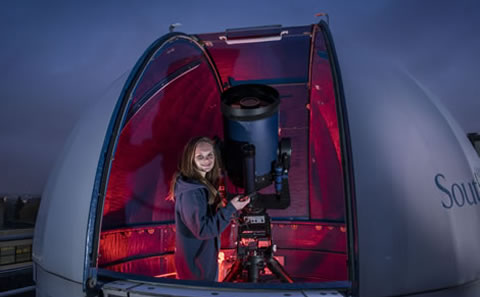
Students can use Southampton's rooftop observatory for their project work.

Fourth year physics students at the University of Southampton have the opportunity to spend time embedded in our research groups, where they work with peers and academic staff on an extended research project.

These MPhys projects, which extend over both semesters of the final year, develop important research skills. Students can choose a project in the field of physics which most interests them. Past projects have included analysing astronomy data from the Cassini satellite, investigating aspects of particle physics using CERN data and performing Raman scattering measurements on nanomaterials to study their optical, electronic and vibrational properties.

Here's a round-up from three projects that were completed this summer:

Applying Bayesian Inference techniques to financial market data

James Stephens developed an algorithm during his final year project that applied Bayesian Inference techniques used in particle physics simulations to the analysis of financial market data. He wrote the algorithm using Python, a coding language he learnt during the second year of his degree.

“I thoroughly enjoyed the independence of creating my project from scratch, with the comfort in knowing I’m being supervised by an expert in their field,â€? James says. “It was satisfying to be able to use the knowledge I accumulated over my degree to tackle a real-world problem outside of physics, namely in the area of mathematical finance.â€?

James worked alongside Dr Andreas Jüttner from the Southampton High Energy Physics (SHEP) Group to produce a final product that could precisely determine the parameters of artificial stock market data.

“The skills and knowledge attained from this project gave me the confidence to move on to a Software Implementation Analyst job at an algorithmic multi-equity trading firm in London,â€? he says. “They made it clear after the interview process that the problem-solving mind-set that was refined during my physics degree is what set me apart from computer science graduates competing for the same job.â€?

Investigating the Hubble constant

Jenny Edwards spent her final year project investigating the Hubble constant, a measure of the rate of acceleration of the Universe. This measurement can in turn be used to define several important cosmological parameters, including the age of the Universe and amount of dark energy it contains.

Jenny worked with Professor Mark Sullivan from the Southampton Astronomy Group on her project as she measured the brightness of exploding dead stars known as supernovae. She advanced the project with data from the University’s rooftop observatory and The Liverpool Telescope in La Palma, Spain.

“The experience was really interesting because it was a chance to specialise and do in-depth research on a topic I enjoy,â€? she says. “I particularly enjoyed the fact we were able to do our own data collection using the Southampton telescope. It meant some late - and cold – nights as we collected our own measurements and contributed live data to the project, which improved our analysis skills as we had to do a lot of calibration.â€?

Jenny is set to begin the defence engineering graduate scheme with Lockheed Martin UK in September.

“I am confident this project has helped me going forward,â€? she says. “Group work is key in many aspects of life but especially so in an engineering team, where communication is important to be able to produce results when people have different skills.â€?

Using the university cleanroom to fabricate devices for single-photon applications

Chris Meayers gained experience in electron-beam lithography during his project in the University’s world-leading cleanrooms, the largest multidisciplinary facility of its type in the UK. He worked alongside Dr Luca Sapienza, of the Solid State Quantum Optics Group, on the fabrication and characterisation of devices that can be used for single-photon applications.

“The experience was rewarding when you can see how your personal contribution improves the results of research,â€? he says. “I enjoyed fabricating the devices as this was particularly hands-on and developed technical skills beyond what I had learned during the undergraduate degree. I also liked the freedom in choosing how to go about achieving the goals set out by the supervisor.â€?

The source of light in Chris’ project was a nano-scopic diamond implanted with nitrogen, which produces an atom-like electronic level system. The focus of the fabrication was to write gold rings onto the device that then enhance the light emission.

“My studies have definitely prepared me for work in a scientific environment, in both knowledge and mind-set,â€? he adds.

Articles that may also interest you

Share this article FacebookTwitterWeibo

Published: 14 August 2018
Illustration
Professor Otto Muskens has secured three grant awards in a two-week period

Professor Otto Muskens has praised the strength of multi-disciplinary research at the University of Southampton after securing three grant awards in just a two-week period.

The researcher will expand on recent scientific advances in space technologies and nanophotonics across the three projects, which represent a research income of around £1m to Southampton’s School of Physics and Astronomy.

The three projects for the Integrated Nanophotonics Group have been awarded by the Engineering and Physical Sciences Research Council (EPSRC), the Leverhulme Trust and the European Commission’s Horizon 2020 programme.

“These grants will allow us to continue delivering new and original research that sustains the excellence of our School,â€? Otto says. “I think it is very important that we work together across our expertise in Engineering and Physical Sciences. Most of the excellent research in our Faculty is done with the input of many different teams and skills, and this is one particular strength of Southampton.â€?

The new Horizon 2020 SMART-FLEX project is aimed at creating smart and flexible metamaterial coatings for spacecraft and satellites. The research follows on from the EU-funded META-REFLECTOR project and will involve an international consortium of space tech partners.

The funding from the Leverhulme Trust will explore the extraordinary nonlinearities of light in complex media.

“We have been intrigued for a number of years by how light interacts with complex nanomaterials, in which light waves bounce around like in a nanoscale pinball machine,â€? Otto continues. “We will be targeting fundamental physics questions such as the existence of Anderson localisation, for which Philip Anderson received the Nobel Prize but which has never been demonstrated for light.â€?

The new grant from the EPSRC will allow researchers to share expertise of ultrafast nano-optics. The project will open up access to Southampton’s Chameleon Ultra II laser system to early stage researchers and fellowship holders that would otherwise not have access to comparable capabilities.

“It was certainly a nice surprise to get three grants at more or less the same time, but it was the result of many months of preparation,â€? Otto adds. “The three grants reflect very different aspects of the group’s activities, from very applied to very basic research.

“We are engaging in multi-disciplinary teams. For example, the SMART-FLEX project will involve Professor Kees de Groot from the School of Electronics and Computer Science and Professor Dan Hewak from the University’s Zepler Institute for Photonics and Nanoelectronics. Nanofabrication in Southampton’s world-class clean rooms is an important aspect of our research and takes up a lot of time and resources. To combine new materials and devices with optical experiments is challenging, but over the years we have built a strong track record and international visibility in this area.â€?

Articles that may also interest you

Share this article FacebookTwitterWeibo

Published: 9 August 2018
Illustration
Physicist Masanori Hanada will join Southampton's School of Physics and Astronomy after receiving a prestigous Ernest Rutherford Fellowship

Physicist Masanori Hanada will help broach ground-breaking new interdisciplinary research opportunities at the University of Southampton through a prestigious fellowship.The early career researcher will arrive in Southampton’s School of Physics and Astronomy this October after securing an Ernest Rutherford Fellowship from the Science and Technology Facilities Council (STFC).

The five-year fellowship, one of just 12 granted annually, will interface between the University’s String Theory and Holography Group and Southampton High Energy Physics (SHEP) theory group, which are combined within the Southampton Theory Astrophysics and Gravity (STAG) Research Centre.

Dr Andreas Jüttner, a Principal Research Fellow in Physics and Astronomy, says: "The award of this extremely prestigious and competitive fellowship comes at the best possible moment in time. We are concentrating our forces toward computing holographically the quantum mechanical wave function of the early universe by making use of methods from mathematical physics, particle physics and large-scale numerical simulations on state-of-the-art high-performance computers. Masanori has expertise and a strong track record in all of these disciplines that will strengthen Southampton's role as a world-leader in the areas covered by STAG Research Centre."

STFC Ernest Rutherford Fellowships help future scientific leaders establish strong, independent research programmes and seek, in part, to attract outstanding overseas researchers to the UK.

Masanori will be arriving from the University of Colorado Boulder in the USA, where he has been expanding his expertise as a Research Associate. His experience includes spells as an Associate Professor at the Yukawa Institute for Theoretical Physics at Kyoto University, Japan, a Visiting Scholar at Stanford University, USA, and a Visiting Scientist at the Lawrence Livermore National Laboratory, USA.

Physics and Astronomy at Southampton has previously collaborated with Masanori on research themes such as lattice gauge theory, a topic for which the University has established an international reputation. In 2016, the University organised and hosted the International Symposium on Lattice Field Theory, which included over 400 attendees from around the world.

Articles that may also interest you

Share this article FacebookTwitterWeibo
How does Clearing and Adjustment work? Clearing FAQs View all Clearing vacancies

Specialised MPhys degrees

Our specialised MPhys degrees provide the opportunity to focus on your chosen field. Study physics with astronomy, space science, mathematics, nanotechnology or photonics.

Pages