You’ll learn about the fundamentals of conducting science from space, applying your core physics knowledge to exciting fields such as:
- space-based astronomy, including the use and design of X-ray and gamma-ray telescopes
- astronautics, including spacecraft and instrumentation design, launch, orbit and re-entry – this is taught by the University’s highly regarded space engineers
- the space environment and space weather through the study of space plasma physics
A unique feature of the course is the one-week Tenerife study trip, where you’ll be challenged to produce a convincing proposal for a space science mission, working as part of an international and interdisciplinary team. You’ll design a space-based telescope and its instrumentation, plan its launch and orbit, and present your proposal to a panel of experts, as though applying for European Space Agency funding.
In the final year you’ll put your scientific training into practice. Working with another student, you’ll conduct an in-depth research project on an aspect of space science or astronomy that interests you. You’ll have access to real research data, for example:
- data generated by European Space Agency and NASA missions, to investigate the space environment around Earth, Saturn or other planets in our solar system
- data from our state-of-the-art monitoring instrumentation in the Arctic, to study the fine-scale processes of the aurora
View the 2019/20 programme specification document for this course
View the 2020/21 programme specification document for this course
Research-grade facilities
You’ll use state-of-the-art equipment in our teaching laboratories, with guidance from expert technicians who are there to support your experimental work. Specialist facilities include:
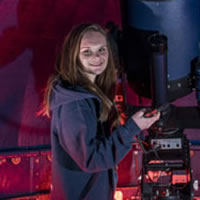
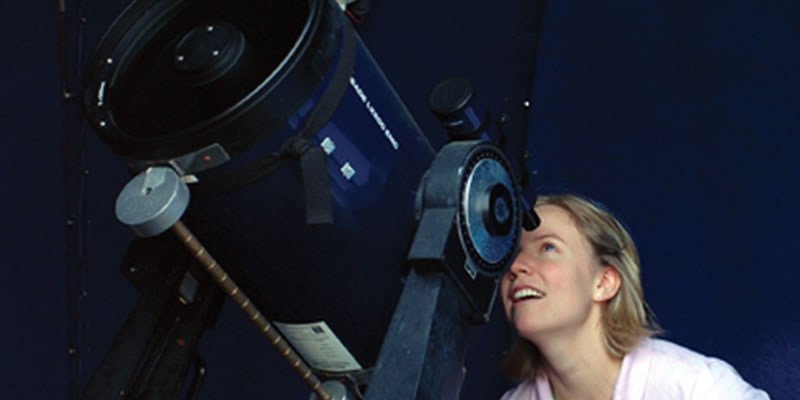
- an observatory on the roof of the Physics and Astronomy building with high-spec telescopes
- a photonics lab with the latest laser equipment
- one of the world's most powerful supercomputers
- a £120m clean room for fabrication at the atomic level – one of the best of its kind in Europe
You’ll also benefit from our recently refurbished Physics and Astronomy foyer, with a specialist library and dedicated study spaces.
A top-five research department
Study with us and you’ll join one of the top five Russell Group departments for physics and astronomy research (REF 2014). Our research reputation is built on a track record of discovery and we remain on the frontline of new developments. For example, Southampton physicists were instrumental in the development of erbium doped amplifiers – components that make today’s internet possible – and more recently our scientists were involved in detecting gravitational waves and light from the collision of two neutron stars for the first time.
You’ll be taught by physicists and space engineers who are actively involved in space science research. For example, you’ll work with staff who have put a gamma ray telescope into space with the European Space Agency. This means you’ll hear about discoveries as soon as they happen – often before they are published in the media – and we regularly update our modules based on new findings.
Accreditation
Our MPhys Physics programmes are accredited by the Institute of Physics
Programme Structure
Throughout the degree you’ll study core physics subjects alongside your specialist space science modules. In year four you’ll be able to choose from a wide range of optional modules, enabling you to deepen your knowledge in specialist fields of physics or study space science-related topics such as oceanography and hydrology.
You could also broaden your intellectual horizons by studying a language or choosing from a range of innovative cross-disciplinary modules, on topics as varied as business, music, law and earth sciences.
If you change your mind about your field of study after you arrive, it’s possible to switch from the MPhys Physics with Space Science degree to the MPhys Physics, BSc Physics or MPhys Physics with Astronomy programme before the end of the first year.
To Apply
All undergraduate applications for Physics and Astronomy should be made online through the Universities and Colleges Admissions Service (UCAS).
Find out how to apply and get further details about UCAS' website, phone and contact details.
Key Facts
This degree includes a field trip to Tenerife where you'll work on a space science mission design project
Study the fundamentals of physics as well as space-related fields, from astronomy to satellite design and space plasma physics
With the global space market set to almost double by 2030, your skills will be in high demand (The House of Commons Space Sector report, 2017)