Research in the QLM group is at the cutting edge of physics and technology
The Quantum Light and Matter (QLM) group encompasses several research topics at the University of Southampton, sharing a common interest in the study of the nanoscale properties of matter (atoms to solids) and their interactions with light.
The group's work aims to advance the fundamental understanding of quantum physics, whilst exploring a broad range of applications in nanoscience and quantum technology. Professor Otto Muskens was appointed Head of Group in August.
"In the QLM group you can find a number of research themes, most of which are rooted in the desire to develop fundamental physical understanding but often lead to significant practical applications," Otto says.
"In recent years the group has seen a rapid growth in novel quantum technologies research primarily involving photons and polaritons, mixed states of light and matter, as carriers of quantum information. Several of our groups are developing and studying advanced materials in contexts such as new nanoelectronic devices, biomedical and energy applications."
Members of the QLM group extend the limits of spectroscopy including terahertz, ultrafast and x-ray imaging. Dr Marcus Newton recently secured a UKRI Future Leaders Fellowship in coherent x-ray imaging that highlights the team's strong involvement in the Diamond Light Source synchrotron facility.
The group holds a wide portfolio of funded projects including an EPSRC Programme Grant on Hybrid Polaritonics led by Professor Pavlos Lagoudakis, and many QLM academics are contributing in multi-disciplinary activities such as the ADEPT Advanced Devices by Electroplating and the Metadevices & Metasystems Programme Grants.
"Several groups in QLM are heavily involved in Quantum Technology Hubs, and we are right now seeing new start-up companies emerging from this research," Otto says.
QLM is based in Building 46 on Highfield Campus, with the group currently consisting of 16 academics, 17 researchers and 26 postgraduate students. Several staff have joined the team in recent years, including Dr Patrick Ledingham, who arrived in July, and Professor Ivette Fuentes-Guridi, who started in September.
"Over the years QLM has built very strong links with other parts of Engineering and Physical Sciences and the wider University, driven by joint scientific interests in multi-disciplinary research," Otto says. "For example, the work by Professor Antonios Kanaras on nanomaterials for biomedicine involves many colleagues in the Institute for Life Sciences and General Hospital. The Southampton cleanrooms are a centre point of activity and we see a lot of collaboration between researchers of QLM, the Optoelectronics Research Centre and the Electronics and Computer Science Sustainable Electronic Technologies group.
"The free flow of ideas between these departments is extremely fruitful and our scientific approaches are complementary in many ways which is perhaps why Southampton is so successful in this area of research. The interface between fundamental scientific ideas and state-of-the-art nanofabrication facilities proves an extremely stimulating environment for new and exciting research."
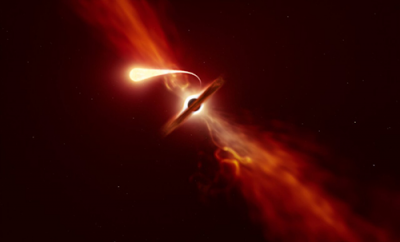
A star is sucked into a supermassive black hole during a tidal disruption event. Credit: ESO/M. Kornmesser
Astronomers have recorded a rare glimpse of a star being shredded into thin streams of spaghetti-like material by a supermassive black hole.
An international research collaboration, including the University of Southampton postgraduate student Tomás E. Müller-Bravo, has reported the sighting of the closed ever observed example of the phenomenon known as a tidal disruption event (TDE).
The burst of light produced during the 'spaghettification' of a star is often obscured by dust and debris. Crucially, the AT 2019qiz TDE was found just a short time after the star was ripped apart, providing rich data that can increase the understanding of supermassive black holes and how matter behaves in extreme gravity environments.
Researchers from the Public ESO Spectroscopic Survey of Transient Objects group, known as ePESSTO+, have published their findings this week in the Monthly Notices of the Royal Astronomical Society.
Mr Müller-Bravo, of the Southampton Astronomy Group, says: "A TDE happens when a star orbits too close to a supermassive black hole and is pulled apart by its immense tidal force. Part of the disrupted star starts orbiting the black hole, while the rest is ejected.
"Due to its unprecedented proximity, this TDE was well monitored in the ultraviolet and optical ranges of the electromagnetic spectrum, but also observed in X-rays and radio wavelengths, producing a very rich dataset. From very early observations we were able to see behind the curtain of dust and debris, which allows us to have a better idea of the physical picture behind these events."
The AT 2019qiz event involved a star with roughly the same mass as our own Sun, just over 215 million light-years from Earth in a spiral galaxy in the constellation of Eridanus. Around half of the star's mass was lost to a black hole of over a million times its size.
Researchers carried out observations over a six-month period as the flare grew in luminosity and then faded away.
The collaboration gathered the data using telescopes from the European Southern Observatory (ESO) and other organisations around the world.
Mr Müller-Bravo is in charge of the data-reduction code for ePESSTO+ that transforms raw data from telescope images into ready-to-use data for the analysis. He performed observations using the New Technology Telescope (NTT) on ESO's La Silla observatory in Chile during the newly published research and supported the collaboration's analysis.