On the MPhys Physics with Astronomy course you’ll gain a robust understanding of core physics concepts and practical lab skills, while developing your astronomy knowledge to an advanced level.
You’ll be joining a vibrant community of like-minded astronomers. The student Astronomy Society meets every week to observe the skies, and organises astronomy trips and social activities. And the Physics and Astronomy department hosts regular astronomy talks, where you can hear about the latest astronomy projects and discoveries.
You don’t need any prior astronomy knowledge to join the programme – an introductory astronomy module in year one provides the foundation you’ll need for specialised studies in later years. As you progress, you’ll gain a more in-depth understanding of:
- the make-up, dynamics and environment of galaxies
- the life cycle of stars
- how radiation is produced and detected in a cosmic setting
- the space environment and space weather
- concepts of modern cosmology (the study of the origin and evolution of the universe) including the nature of dark matter
Your understanding of astronomy will be underpinned by your broader physics studies. Year one modules cover energy and matter, electromagnetism, special relativity and the foundational theories of quantum physics. You’ll gain more in-depth knowledge as you progress, applying your learning in areas such as particle and atomic physics. You’ll also develop the mathematical skills to model real-world problems and analyse data, and the practical skills to work confidently in the lab and design your own experiments.
For your extended project in year four you can choose to work with one of our astronomers on a project related to their area of expertise. You could use our on-site observatory to collect and interpret your own data, or work with high-quality data from other ground or space-based telescopes. Many of our students produce results of publication quality.
View the 2019/20 programme specification document for this course
View the 2020/21 programme specification document for this course
Research-grade facilities
Throughout the programme you’ll use state-of-the-art equipment in our teaching laboratories, with guidance from expert technicians who are there to support your experimental work.
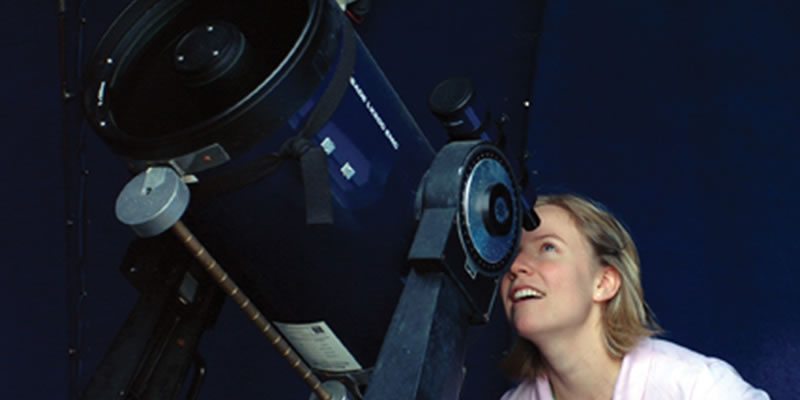
Our superb astronomy facilities couldn’t be closer to hand – there is an observatory on the roof of the Physics and Astronomy building, equipped with two high-spec telescopes and CCD detectors for astronomy imaging. You’ll be able to use these for your fourth-year project work.
You’ll also benefit from our recently refurbished Physics and Astronomy foyer, with a specialist library and dedicated study spaces.
A top-five research department
Study with us and you’ll join one of the top five Russell Group departments for physics and astronomy research (REF 2014). Our research reputation is built on a track record of discovery and we remain on the frontline of new developments. For example, Southampton physicists were instrumental in the development of erbium doped amplifiers – components that make today’s internet work – and more recently our scientists were involved in detecting gravitational waves and light from the collision of two neutron stars for the first time.
You’ll hear about the latest research findings, often before they are published or reported in the media, from lecturers who are directly involved in outstanding research. Our Astronomy Research Group is a hub for highly respected research in specialist areas including the evolution of compact objects and the space environment. Two of our Astronomy staff are Royal Society Fellows, a prestigious award that demonstrates research of the highest calibre.
Accreditation
Our MPhys Physics programmes are accredited by the Institute of Physics
Programme Structure
On the MPhys Physics with Astronomy course, you’ll be able to select from a range of optional modules. You could explore a physics specialism that interests you, study a language or broaden your intellectual horizons by choosing a module from another discipline, such as business, music or earth sciences.
Because all our programmes share the same core modules in the first and second year, it’s also possible to switch to one of our other physics degrees before the end of year two, provided you have taken the required options.
To Apply
All undergraduate applications for Physics and Astronomy should be made online through the Universities and Colleges Admissions Service (UCAS).
Find out how to apply and get further details about UCAS' website, phone and contact details.
Key Facts
100 per cent of our Physics and Astronomy research has been rated world leading or internationally excellent for its impact on society (REF 2014)
You could choose to become a professional astronomer, or use your advanced computing and data analysis skills in another profession
You'll have the chance to spend a week using research-grade telescopes in Tenerife
This degree is the gateway to the Astrophysics with a Year Abroad flagship programme, where you will undertake a research placement at the Harvard-Smithsonian Center for Astrophysics